
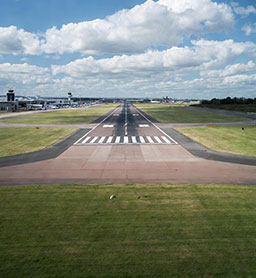
Airfields have more grass than almost any other kind of site, and all of it has to be kept in order around the rhythm of flying. Between the grass margins, the perimeter, the areas around hangars, and the amenity grounds that visitors see first, a surprising share of a small airfield team’s week goes into cutting. A robotic mower for airfields takes the repetitive part of that work off the schedule. This guide explains where it fits, what to ask a supplier, and how to plan it safely, whether you run a grass strip in Lancashire or a larger operation elsewhere in the UK.
Thinking about automation for your airfield? Book a free consultation with Greenway Robotics, or see our full range of commercial robotic mowers.
Why airfield grass is a maintenance challenge of its own
Most commercial sites have a lawn problem. Airfields have a land management problem. The grassed area is vast compared with the size of the team looking after it, it grows quickly through the summer, and it can only be worked on in the gaps between aircraft movements. Many general aviation airfields run with a small paid team or a handful of volunteers, so every hour spent on routine cutting is an hour not spent on the runway inspection, the fuel store, the clubhouse, or the visitors.
There is also a reliability point. A mowing schedule that depends on whoever happens to be free on a given day produces patchy results, with long grass in one area and freshly cut grass in another. Frequent, automated cutting produces a more even result and removes the scramble when a fly-in event or an inspection is coming up.
Where robotic mowing can fit on an airfield
The right answer depends entirely on the airfield, which is why a site assessment comes first. In general, the areas that tend to suit automation are the ones that are large, grassed, and away from active aircraft movements:
- Amenity grounds around the clubhouse, café, and visitor areas
- Grass margins beside hangars, car parks, and access roads
- Perimeter and boundary grass where access is straightforward
- Open fields used for events, camping, or overflow parking
- Large grassed areas on the wider estate that the airfield operator maintains
Operational surfaces are a different matter. Anything connected with the movement area is governed by aviation safety requirements, and any proposal there needs to be agreed with the airfield operator and its safety lead before it goes anywhere near a machine. A good supplier will say this plainly rather than promise to cover everything.
Safety first: working in a regulated environment
Greenway Robotics builds its systems for regulated, high risk environments where precision, consistency, and compliance matter, and an airfield is exactly that kind of place. In practice, safe operation comes down to a few things that should be settled before installation:
- Exclusion zones. Boundaries are mapped so the mower is kept out of any area it should not enter, and the mapping is checked on site rather than assumed from a plan.
- Scheduling around movements. Cutting windows are set around flying times, so the mower is not working in an area at the wrong moment.
- Obstacle detection. Onboard sensors respond to people, vehicles, and objects that were not there when the site was mapped.
- Clear ownership of safety decisions. The airfield operator remains responsible for its own safety management, and the supplier should work to the operator’s procedures, not the other way round.
Grass height can also be tied into an airfield’s wider wildlife and safety management arrangements, so it is worth raising your own policies with a supplier early. The right schedule is the one that fits your procedures.
Choosing the right machine for an airfield
Airfield grounds vary from a compact grass strip to a large estate with several distinct areas. For extensive grassed areas, a commercial robotic mower for large scale grounds provides the capacity to cover significant acreage on a regular schedule. Where the ground is varied, with amenity lawns, margins, and event fields all on one site, a multi-functional robotic mower adapts across the different areas rather than needing a separate machine for each. Smaller airfields and flying clubs working to a tighter budget can still achieve professional results with an affordable robotic mower for commercial sites.
The honest approach is to match the machine to the specific areas you want automated, not to the total acreage of the airfield. A site assessment will usually identify a handful of areas where automation makes an immediate difference.
What installation looks like on an airfield
Installation follows the same stages as any commercial site, with extra care around access and safety:
- Site assessment with the operator. A visit to walk the areas under discussion, agree which are in scope, and understand the airfield’s procedures and access rules.
- Boundary and obstacle mapping. Precise mapping of each zone, with exclusion areas set and verified on the ground.
- Charging station placement. Positioned for efficient coverage and sensible access, away from anywhere that could cause a problem.
- Supervised running period. The system runs under observation first, so any gaps in the mapping are found before it operates unattended.
- Handover. Staff or volunteers are shown how to check status, pause the system, and adjust the schedule, and who to call if something needs attention.
A phased approach tends to work best, starting with the amenity grounds and one or two margins, then extending as confidence builds.
Concerns airfield managers raise most often
A few questions come up in almost every conversation. The first is whether a robotic mower could stray into somewhere it should not be. The answer is that boundaries are mapped and verified on site, and exclusion zones are part of the mapping, which is why the supervised running period matters so much. The second is how it copes with the unexpected, such as a vehicle, a person, or an animal. Onboard sensors detect obstacles and the mower stops or redirects, and scheduling keeps it away from busy periods in the first place. The third is who is responsible if something changes. Boundaries can be updated when the layout changes, and the operator stays in charge of its own safety decisions throughout.
Another common worry is noise and disturbance for neighbours and visitors. Robotic mowers are considerably quieter than traditional equipment, which helps at airfields that sit close to housing or that run events and fly-ins. A quiet mower working in the background is also far less likely to distract anyone around the clubhouse or the visitor areas.
Seasonal scheduling on an airfield
Grass growth on an airfield follows the usual UK pattern, with fast growth in spring and early summer, slower growth in autumn, and very little in winter. A well-configured system adjusts its cutting frequency through the year rather than running a fixed routine, so you are not over-cutting in the quiet months or falling behind during the peak. It is worth asking any supplier how the schedule adapts, and how easily your own team can adjust it when something changes, such as an event, a fly-in weekend, or a spell of wet weather.
Labour, cost, and the volunteer factor
A lot of UK airfields run on a thin staffing model, and some depend heavily on volunteers. For those sites, routine mowing is exactly the sort of job that is hard to cover consistently across a whole season. Automating it reduces the load on a small team and makes the remaining jobs easier to staff.
For the cost comparison, look beyond the purchase price. Add up what you currently spend on fuel, machinery upkeep, contractor visits, and staff time, and compare that with installation and running costs over several years. A supplier should be able to give you a clear, itemised breakdown after a site visit so you can make that comparison properly.
See it working at St Michaels Airfield
Greenway Robotics is based at St Michaels Airfield in Preston, and prospective customers can visit for a demonstration. Seeing a machine work on real ground tells you far more than a brochure. If you are flying in, prior permission (PPR) is required, or you can visit by road. Contact us to arrange a suitable day and time.
Local support across Lancashire and the North West
Airfields and estates in and around Preston, across Lancashire, and throughout the North West benefit from a supplier with a genuinely local base. Greenway Robotics can attend site assessments quickly, be on hand during the supervised running period, and respond to support requests without the delays of a distant national office. The same installation standards apply to airfields and large grounds across the rest of the UK.
Requirements differ between large licensed aerodromes and smaller general aviation airfields, and the UK Civil Aviation Authority sets the framework that licensed aerodromes work within. Whatever the size of your airfield, any robotic mowing plan should be agreed with your own operator and safety lead before installation.
Frequently asked questions
Who supplies robotic mowers for airfields in the UK?
Greenway Robotics supplies and installs commercial robotic mowers for airfields, golf courses, sports clubs, holiday parks, and other large grassed areas across the whole of the UK, from a base at St Michaels Airfield in Preston, Lancashire.
Can a robotic mower be used on an airfield or at an airport?
Yes, in the right areas and with the right planning. Robotic mowers suit large grassed areas such as amenity grounds, margins, and event fields. Anything connected with the movement area needs to be agreed with the airfield operator and its safety lead, and suitability is confirmed during a site assessment.
Is there a robotic mower supplier near Preston with an airfield demonstration site?
Yes. Greenway Robotics is based at St Michaels Airfield in Preston, Lancashire, and offers demonstrations to prospective customers. Prior permission is required if you want to fly in, or you can visit by road.
How does a robotic mower stay safe around aircraft movements and restricted areas?
Boundaries are mapped so restricted areas are excluded, cutting is scheduled around flying times, and onboard sensors respond to people and objects. The airfield operator remains responsible for its own safety management, and the installation should follow its procedures.
What is the best robotic mower for large grassed airfield areas?
It depends on the area, but a high capacity commercial machine suits extensive grassed areas, while a multi-functional model suits varied ground with amenity lawns, margins, and event fields on one site. A site assessment is the reliable way to match machine to ground.
How do I arrange a robotic mower demonstration at St Michaels Airfield?
Contact Greenway Robotics through the contact page to agree a suitable day and time. If you plan to fly in, prior permission (PPR) is required, otherwise you can visit by road.
Conclusion
Airfields combine large areas of grass with small teams and strict safety expectations, which is exactly where routine mowing becomes a burden. Robotic mowing can take the repetitive cutting off the schedule in the right areas, provided the plan is agreed with the operator and the installation is done carefully. Greenway Robotics is based at an airfield itself, so it understands the setting, and it offers demonstrations on site.
Ready to see what automation could do for your airfield? Get in touch with the Greenway Robotics team to arrange a site assessment or a visit to St Michaels Airfield.