
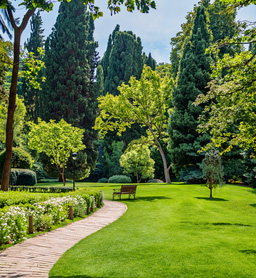
Holiday parks across the UK face a grounds maintenance challenge that few other sites deal with in quite the same way. Large open leisure areas, communal grounds around static caravans and lodges, and shared amenity spaces all need to look presentable throughout a busy season, often stretching from early spring through to autumn, without pulling seasonal maintenance staff away from the many other jobs that keep a park running smoothly. Automated mowers for holiday parks have become an increasingly practical answer to this pressure, and this guide sets out exactly why, along with what park managers need to know before making the switch, whether your park is based in Lancashire, elsewhere across the North West, or further afield in the UK.
The specific pressures holiday parks face
Unlike a golf course or sports club, a holiday park’s grounds maintenance workload is tied directly to occupancy and season. During peak season, when the park is at its busiest, maintenance staff are frequently pulled in multiple directions at once, dealing with guest requests, facility upkeep, and turnover between bookings, all while extensive grounds still need regular attention. Routine mowing, particularly across large open leisure fields and communal areas, can easily become the task that gets squeezed or delayed when everything else takes priority.
An automated mower for holiday parks removes routine mowing from that competition for staff time entirely. Rather than fitting grounds maintenance in around guest facing priorities, the mowing happens automatically on a fixed schedule, freeing park staff to focus on the guest experience without grounds presentation suffering as a result.
Where robotic mowing fits on a holiday park
Holiday parks typically include several distinct types of grassed area, each with slightly different maintenance needs.
Open leisure fields, often used for guest activities, games, and events, need to be presentable and safe underfoot at all times, particularly during peak season when usage is highest.
Communal grounds around static caravans and lodges need regular, tidy maintenance to keep the overall park looking well cared for, directly affecting guest first impressions and repeat booking decisions.
Verges, access roads, and shared amenity areas are easy to overlook but still contribute significantly to how professional and well maintained a park appears overall.
A multi-functional robotic mower is often well suited to holiday parks precisely because of this variety, capable of adapting across open fields, communal areas, and more compact zones within a single site, rather than requiring a separate machine for every distinct area.
Managing large scale grounds efficiently
Larger holiday parks, particularly those with extensive open grounds or multiple leisure fields, benefit from a commercial robotic mower for large scale grounds capable of covering significant acreage reliably across a long operating season. For parks working within a tighter maintenance budget, an affordable robotic mower for commercial sites still delivers professional grass management without the largest capital outlay, making automated mowing accessible even for smaller or independently run parks.
Cutting groundskeeping costs without cutting standards
The financial case for automated mowing at a holiday park tends to be particularly clear cut. Seasonal maintenance staff are often difficult to recruit and retain, particularly during peak summer months when demand for staff across the wider hospitality and leisure sector is highest. Reducing reliance on manual mowing directly reduces the seasonal staffing pressure a park needs to manage, while also cutting fuel and machinery upkeep costs associated with a traditional mowing fleet.
Importantly, this does not mean cutting corners on presentation. If anything, automated mowing tends to improve overall grounds presentation, since cutting happens consistently and frequently rather than depending on whichever staff happen to be available on a particular day during a busy season.
Local installation and support for parks across Lancashire and the North West
Holiday parks based in Lancashire, Cumbria, and the wider North West benefit from a supplier with a genuine local base rather than one operating purely from a distant national office. Greenway Robotics installs and supports parks from its base at St Michaels Airfield in Preston, giving North West operators faster access to site visits, demonstrations, and ongoing maintenance support, while still offering the same installation standards to parks located further afield across the rest of the UK.
Presentation and guest first impressions
First impressions matter enormously for a holiday park, and grounds presentation plays a bigger role in that than many operators initially expect. Guests arriving at a park with neatly maintained communal grounds, tidy verges, and well kept leisure fields form an impression of quality and care before they have even checked in, and that impression tends to carry through into how they rate the wider stay and whether they choose to return the following year. Because robotic mowing maintains grounds consistently rather than in periodic bursts, parks using automated mowing often report a noticeably more even standard of presentation across the whole season, rather than grounds looking their best only in the days immediately following a manual mowing visit.
Independent and family run parks versus larger chains
The financial and operational case for automated mowing applies somewhat differently depending on the scale and structure of the park. Larger holiday park chains often have more established grounds maintenance budgets and existing staff structures, and for these operators, automated mowing tends to be evaluated primarily on cost efficiency and consistency across multiple sites within a portfolio. Smaller, independently or family run parks frequently face a sharper version of the seasonal staffing challenge, since there may be no dedicated grounds team to fall back on when other priorities take precedence, making the labour saving case for automation particularly compelling. Suppliers offering a range of machine sizes and price points, rather than a single premium product, tend to serve both ends of this spectrum well, since a smaller independent park has very different budget constraints to a larger multi site operator.
Operating around guests and peak season activity
A common concern from park managers considering automated mowing is how it will operate safely and unobtrusively around guests, particularly children, pets, and general foot traffic across a busy site. Robotic mowers designed for commercial use include onboard sensors that detect people, animals, and other obstacles in real time, stopping or redirecting rather than continuing on a fixed path regardless of activity around them. Scheduling can also be configured to run during quieter periods, such as early morning or after guests have settled into evening activities, minimising any visible disruption during peak usage hours.
Environmental credentials increasingly matter to guests
Sustainability has become a genuine factor in where guests choose to book, and holiday parks are increasingly expected to demonstrate environmental credentials as part of their overall offering. Electric and solar assisted robotic mowers reduce fuel consumption and emissions compared with traditional mowing equipment, and parks that highlight this as part of their environmental commitments often find it resonates well with guests who actively choose parks based on sustainability, a growing segment of the UK holiday market. Beyond guest perception, reduced fuel dependency also contributes to lower, more predictable running costs across a full season, reinforcing the financial case alongside the marketing benefit.
Preparing grounds for peak season in advance
Parks planning ahead for a busy season benefit from having automated mowing fully installed and tested well before peak occupancy begins, rather than attempting to install during the busiest weeks of the year. Off season and shoulder season periods, when occupancy is lower and grounds staff have more flexibility, tend to be the ideal window for site assessment, installation, and the supervised running period that precedes full automation. Parks that plan installation this way typically enter their peak season with a fully tested, reliable system already in place, avoiding any disruption during the months when grounds presentation matters most.
The Grounds Management Association has consistently pointed to sustainability and consistency of presentation as priorities across the UK leisure and grounds care sector, both of which align directly with what automated mowing delivers for a holiday park. Further detail is available at thegma.org.uk.
Seasonal scheduling for a holiday park
Holiday parks typically experience a clear seasonal pattern, with grass growth and park occupancy both increasing significantly through spring and summer before tapering off into autumn. A properly configured robotic mowing schedule adjusts automatically for these seasonal growth changes, maintaining consistent grounds presentation through the busiest months without requiring park staff to manually adjust settings throughout the season. This is particularly valuable for parks with limited on site technical staff, since the system manages seasonal variation without ongoing manual intervention.
What to look for in a supplier for a holiday park installation
Not every robotic mower supplier has direct experience with the specific demands of a holiday park environment. Look for a supplier who understands the balance between guest safety, seasonal occupancy patterns, and the variety of grassed areas typical of a holiday park site, rather than one applying a generic large area approach without accounting for these factors. A proper site assessment should cover guest safety considerations specifically, alongside the usual terrain and boundary mapping that any commercial installation requires.
Frequently asked questions
Do automated mowers work well on holiday parks?
Yes. Automated mowers are well suited to holiday parks, handling open leisure fields, communal grounds, and shared amenity areas reliably, with onboard sensors designed to detect and safely respond to guests and pets moving around the site.
How much does an automated mower for a holiday park cost?
Cost depends on the size and layout of the park, but should be considered alongside the seasonal staffing costs and traditional mowing equipment expenses it typically replaces, which often makes the overall financial case clearer than the upfront price alone suggests.
Can a robotic mower operate safely around guests and children?
Yes. Commercial robotic mowers include obstacle detection sensors that respond to people, pets, and other movement in real time, and scheduling can be configured to run during quieter periods to minimise disruption during busy guest hours.
What areas of a holiday park can a robotic mower cover?
Robotic mowers can cover open leisure fields, communal grounds around caravans and lodges, verges, and shared amenity areas, with a multi functional machine often well suited to the variety of terrain typical across a single holiday park site.
Does automated mowing reduce holiday park staffing costs?
Yes, in most cases. Removing routine mowing from the seasonal maintenance workload reduces the staffing pressure parks face during peak season, when recruiting and retaining seasonal staff is often most difficult.
Who supplies automated mowers for holiday parks in the UK?
Greenway Robotics supplies and installs automated mowers for holiday parks across the whole of the UK, with a range of machines suited to different park sizes and budgets.
Who supplies automated mowers for holiday parks in Lancashire and the North West?
Greenway Robotics supplies and installs automated mowers for holiday parks across Lancashire, the wider North West, and the whole of the UK, from a demonstration site at St Michaels Airfield in Preston.
Conclusion
Holiday parks face a distinctive grounds maintenance challenge, balancing extensive grassed areas against a seasonal staffing pattern that rarely lines up neatly with peak maintenance demand. Automated mowing addresses this directly, keeping open fields, communal grounds, and amenity areas consistently presented without competing for staff time during the busiest parts of the season. For park managers weighing up the switch, the combination of reduced seasonal staffing pressure and lower running costs typically makes a strong financial case alongside the presentation benefits.
To discuss automated mowing for your holiday park, book a free consultation with the Greenway Robotics team.